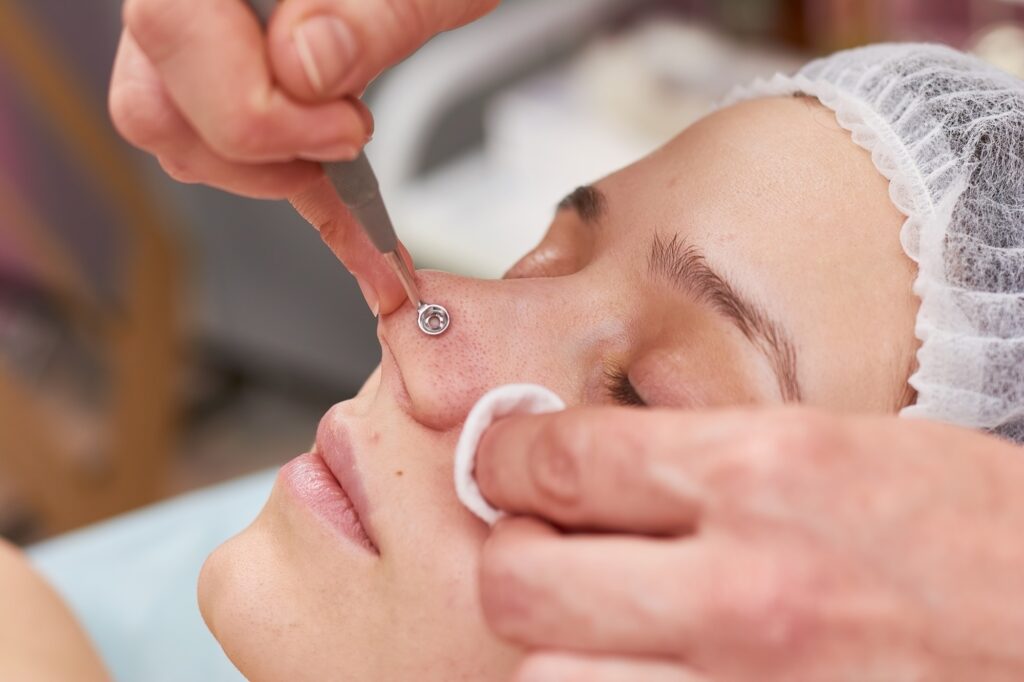
A lump on the nose is hard to ignore. It sits in the centre of the face, it shows in every photograph, and it is close enough to the eyes that people notice it in conversation. Most nose lumps turn out to be ordinary skin cysts, but the nose is also the face’s most common site for skin cancer, and it is home to a rare congenital cyst that should never be removed without a scan. This guide explains what a nose cyst is, how to tell it apart from the other lumps that appear on the nose, how removal methods compare on recurrence and scarring, what to expect on the day and during recovery, and which lumps need a different specialist entirely.
What a nose cyst actually is
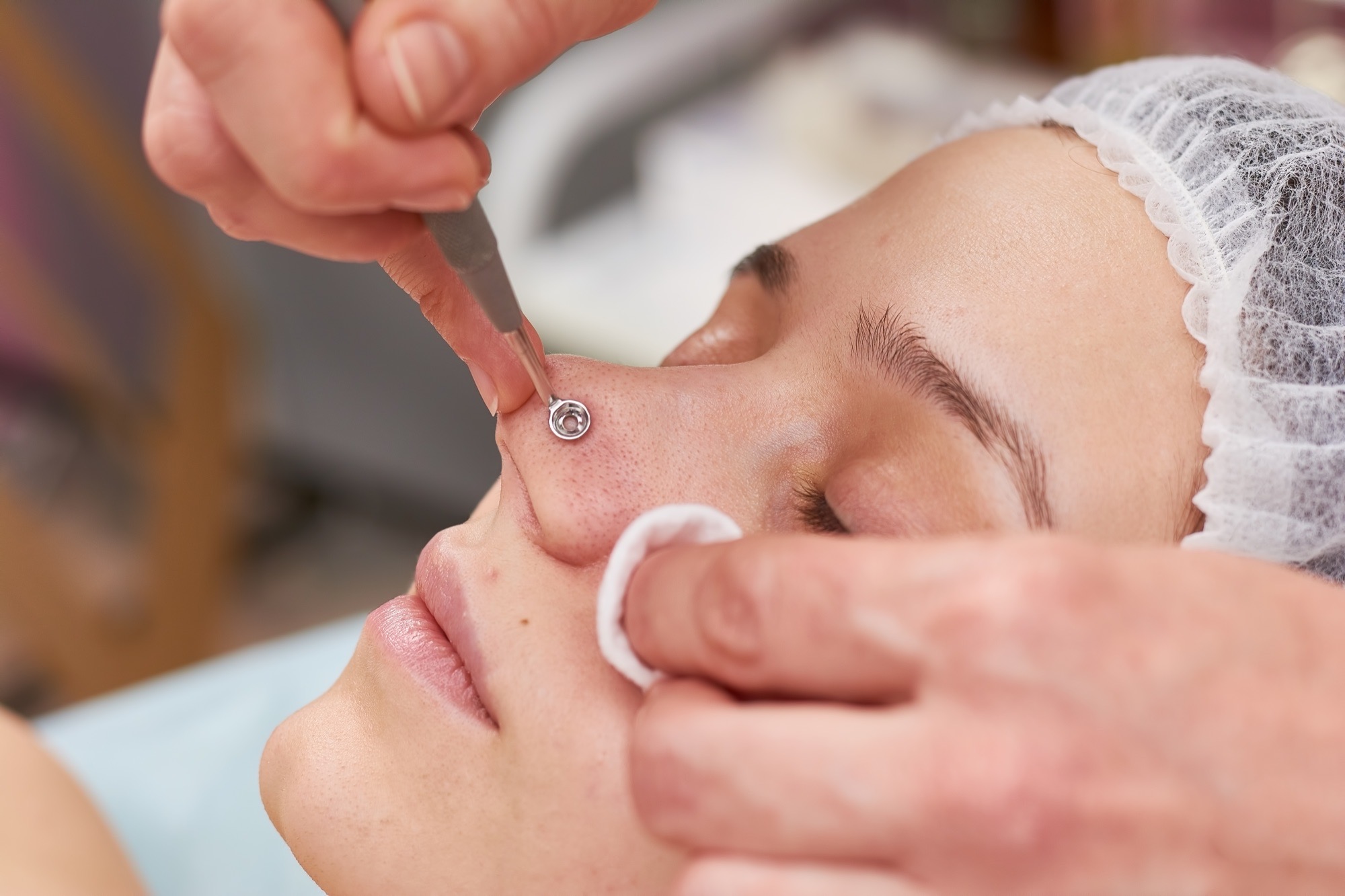
The lump most people call a sebaceous cyst on the nose is usually an epidermoid cyst, also known as an epidermal inclusion cyst. Skin cells that should have shed from the surface become sealed inside a small pocket in the dermis. That pocket is lined with the same type of cells as your outer skin, and it keeps doing what skin does: producing keratin. With nowhere to go, the keratin collects and the cyst slowly enlarges.
That structure explains almost everything about treatment. The cyst cannot resolve by itself, because the lining is alive and still producing. And if the contents are squeezed or drained but the lining is left behind, the pocket refills.
“Removing the entire cystic lining is important in decreasing recurrence.”
Zito PM, Scharf R. Epidermoid Cyst. StatPearls, published by the National Library of Medicine, NIH
Cysts on the nose are usually small, often between a few millimetres and a centimetre, because they are noticed early. They tend to sit on the sides of the nose, the bridge or near the nostril rim, under skin that looks otherwise normal, sometimes with a tiny dark central pore called a punctum.
The six lumps people call a nose cyst
The nose carries a surprising variety of lumps for such a small area, partly because its skin is packed with oil glands and partly because it takes more sun than almost any other part of the face. Getting the label right decides the treatment.
Smooth, firm, dome shaped and moving with the skin, sometimes with a small central punctum. Painless unless inflamed. This is the classic nose cyst and the one a skin clinic removes.
Tiny, hard, pearly white bumps of one to two millimetres, often several together on the nose and cheeks. They are miniature keratin cysts that are released through a tiny nick rather than cut out.
Soft, yellowish bumps with a small central dip, common on the nose and forehead from middle age. Enlarged oil glands rather than a cyst, treated with light energy based methods if they bother you.
A shiny, pearly or skin coloured lump, often with fine visible blood vessels, that may bleed, crust or fail to heal. The most common skin cancer, and the nose is its most frequent site on the face.
A congenital lump in the midline of the nose, usually on the bridge, present from birth or early childhood and sometimes with a small pit or a hair. It can connect deeper towards the skull and is managed by specialist surgeons after imaging.
A tender, red swelling just inside the nostril, usually an infected hair follicle. It is not a cyst and settles with treatment from a GP or pharmacist rather than removal.
Why cysts form on the nose
The skin of the nose is not uniform. Over the bridge it is thin and mobile, while over the tip and the sides of the nostrils it is thick and densely packed with sebaceous glands. Those glands open into follicles that can become blocked, and a blocked follicle is the usual starting point for an epidermoid cyst.
Several things make a blockage more likely. Acne and inflammation around the follicles damage the follicle opening. Minor injuries, including squeezing spots, can push surface skin cells into the deeper layer where they become sealed in. Years of sun exposure thicken and change the skin of the nose, which is also why the nose develops sebaceous hyperplasia and skin cancers more than most areas.
Epidermoid cysts are most common in adults in their thirties and forties, and they are more frequent in men than in women. They are not caused by poor hygiene, and they are not contagious.
Does a nose cyst need removing?
Not necessarily. A small, stable, painless epidermoid cyst that has been confirmed as a cyst can safely be left alone. On the nose, though, most people choose removal sooner than they would elsewhere, for three reasons.
- Visibility. A lump in the centre of the face is noticed by everyone, and many people find it affects their confidence long before it causes any physical symptom.
- Size and scar. A cyst removed while it is small leaves a smaller scar. Waiting until it is larger, or until it has become inflamed, means a longer incision on skin with very little to spare.
- Inflammation. A cyst that ruptures under the skin becomes red, swollen and painful. Inflamed tissue scars more and makes a later operation harder, so removing a cyst between flare ups gives a cleaner result.
Whatever the reason, the lump should be examined before it is treated. The value of an assessment on the nose is less about the cyst itself and more about making sure it is not one of the lumps that need a different plan.
Nose cyst removal options compared
There are three tiers of treatment, and on the nose the differences between them are mostly about the scar.
Watch and manage
- ObservationReasonable for a small, stable, painless cyst with a confirmed diagnosis.
- Warm compressEases discomfort in an inflamed cyst. Does not remove it.
- Hands offNo squeezing, picking or needles at home.
- Photograph monthlyThe simplest way to notice a change in size, colour or surface.
Definitive removal
- Complete surgical excisionSac removed intact. Lowest recurrence, at 3.3% at 12 months.
- Minimal or punch excisionMuch smaller scar. Recurrence 8.3% at 12 months.
- Incision and drainageFor acute infection only. The lining stays, so it refills.
- HistologyTissue sent to pathology to confirm the diagnosis.
Scar control
- Incision placementFollowing the natural contours of the nose so the scar sits in a shadow or crease.
- Fine suturesVery fine stitches, removed early to avoid track marks.
- Silicone gelApplied once the wound has fully closed.
- Sun protectionA new scar on the nose darkens easily in sunlight.
The choice between complete excision and a minimally invasive approach has been tested directly on the face, which makes it unusually relevant to the nose. A study of 120 patients randomised facial epidermal cysts to conventional complete surgical excision or minimally invasive removal through a small opening made with a CO2 laser, then followed them for 12 months:
| Measure | Complete surgical excision | Minimally invasive laser excision |
|---|---|---|
| Patients | 60 | 60 |
| Recurrence at 12 months | 3.3% | 8.3% |
| Statistical difference | None (P = 0.648) | |
| Mean scar length | 1.23 cm | 0.30 cm |
| Scar difference | Significant (P = 0.001) | |
| Patient satisfaction | Lower | Significantly higher |
The authors found that “the cosmetic outcome of CO2 laser excision is excellent” and recommended the technique for cysts of 2.2 cm or smaller where appearance matters. Recurrence was numerically higher in that group, although the difference was not statistically significant.
For the nose, the practical reading is that small cysts, which most nose cysts are, often suit a minimal approach that keeps the scar as short as possible. A larger, deeper or repeatedly inflamed cyst usually needs a full excision, with the incision planned around the shape of the nose so that the scar follows a natural line.
Incision and drainage sits outside that comparison. It relieves an acutely infected, painful cyst, but it is a holding measure: the lining remains, so a planned removal is still needed once the inflammation has settled, usually after four to six weeks.
What happens on the day
Nose cyst removal is a same day procedure carried out under local anaesthetic. The NHS describes the approach for skin cysts: “Local anaesthetic is used to numb the area around the cyst before it’s cut out. You’ll have a small scar after the wound has healed.” Expect to be in clinic for around an hour, with the procedure itself usually taking 20 to 30 minutes.
Assessment
The procedure
Immediate care
Recovery and scarring on the nose
The face has an excellent blood supply, so wounds on the nose usually heal quickly and well. The challenge is not healing but appearance. The nose has very little loose skin, so a wound cannot always be closed by simply pulling the edges together, and the thick, oily skin over the tip and around the nostrils can leave a scar that looks slightly sunken or more visible than one on the bridge.
That is why planning matters more than speed. Keeping the incision small, placing it along the natural lines and shadows of the nose, using fine sutures and removing them early all reduce how noticeable the final scar is. Most scars on the nose start pink and fade over several months.
Do
- Keep the dressing clean and dry for the first 48 hours
- Sleep with your head slightly raised for the first night or two to limit swelling
- Take paracetamol if the area feels sore
- Return for suture removal at five to seven days
- Start silicone gel once the wound has fully closed
- Use a high factor sunscreen on the scar every day for at least three months
Avoid
- Blowing your nose hard in the first few days
- Glasses that rest on the wound, where possible, until the sutures are out
- Makeup on the wound until it has fully closed
- Swimming, saunas and steam rooms for two weeks
- Picking at the crust or sutures
- Strenuous exercise for the first few days
Glasses are the detail people forget. Frames that sit on the bridge of the nose press directly on a healing wound there, so it is worth planning the procedure around a few days when you can wear contact lenses or do without.
Risks and recurrence
Nose cyst removal is a minor procedure with a low complication rate, but it is still surgery. The main risks are infection, bleeding or bruising, a scar that is more noticeable than expected, and recurrence.
Recurrence depends mainly on whether the whole lining was removed. In the facial cyst study above, 3.3% of cysts came back within 12 months after complete excision and 8.3% after the minimal laser technique. A cyst that is drained rather than removed should be expected to refill. A cyst that has been inflamed or ruptured before surgery is more likely to recur, because the lining can be harder to separate cleanly from the scarred tissue around it.
Sending the tissue for histology is standard. It confirms that the lump was an ordinary cyst and rules out anything that needs further treatment.
Lumps inside the nose are a different problem
Everything above applies to cysts on the skin of the nose. A lump or swelling inside the nostril or nasal passage is usually something else. A tender, red bump just inside the nostril is most often an infected hair follicle and is treated by a GP or pharmacist. Soft swellings deeper inside the nose that cause blockage or a reduced sense of smell may be nasal polyps or sinus problems, which are assessed by a GP and, if needed, an ear, nose and throat specialist.
None of these are skin cysts, and none of them are removed in a skin clinic.
Red flags: when a nose lump needs more than removal
Most nose lumps are harmless, but the nose deserves extra caution because it is the most common site on the face for skin cancer. In a study of 371 facial basal cell carcinomas, 38.8% were on the nose, and nasal cancers tended to appear earlier and to be smaller than those elsewhere on the face.
Ask for an assessment before any removal if a lump on your nose:
- looks shiny, pearly, translucent or waxy, or has fine blood vessels across its surface
- bleeds easily, crusts, or forms a sore that does not heal within four weeks
- grows quickly, changes colour or develops an irregular edge
- is a midline lump on the bridge of the nose that has been present since childhood, especially with a small pit or a hair coming from it
The last point matters because a nasal dermoid cyst can have a tract running back towards the skull. In one series of 22 patients with nasal dermoid sinus cysts, ten, or 45%, had intracranial extension. These lesions are scanned with MRI or CT and removed by specialist surgeons, never treated as a simple cyst.
Seek urgent medical advice if a nose lump becomes rapidly red, hot and swollen with spreading redness, fever or swelling around the eye. These suggest a spreading infection that needs prompt treatment rather than a planned procedure. Related lesions are covered on our skin cysts and skin lumps and bumps pages, and you can read more about the procedure on our cyst removal treatment page.
FAQs
Will a cyst on my nose go away on its own?
No. An epidermoid cyst is lined with living skin cells that keep producing keratin, so it has no mechanism for resolving. It may stay the same size for a long time, and an inflamed cyst may calm down, but the cyst itself will not disappear. Only removal of the lining clears it permanently.
Can I squeeze or pop a nose cyst?
No. The NHS advises against squeezing any skin cyst, because it can rupture the sac, spread the contents and cause infection. On the nose, squeezing also scars the tissue, which makes the eventual removal harder and the final scar more visible.
Does nose cyst removal hurt?
The local anaesthetic injection stings for a few seconds. After that the area is numb and the procedure is felt as pressure only. Most people need nothing stronger than paracetamol afterwards, and the area may be slightly swollen or bruised for a few days.
Will nose cyst removal leave a scar?
Any removal leaves a scar, but on the face it is usually small and fades well. In a study of facial cysts, minimally invasive removal left a mean scar of 0.30 cm against 1.23 cm for full excision. Small incisions placed along the natural contours of the nose, fine sutures and sun protection all help the scar settle.
How long does nose cyst removal take and what is the recovery?
The procedure usually takes 20 to 30 minutes, with around an hour in clinic. Most people return to work the same or next day. Sutures on the face are usually removed after five to seven days, and the scar continues to fade over several months.
Will a nose cyst come back after removal?
Recurrence was 3.3% at 12 months after complete surgical excision of facial cysts and 8.3% after minimally invasive laser removal. If the cyst is only drained and the lining is left behind, it should be expected to refill.
Is a lump inside my nostril a cyst?
Usually not. A tender red bump just inside the nostril is most often an infected hair follicle, and swellings deeper in the nose may be polyps or sinus problems. These are treated by a GP, pharmacist or ear, nose and throat specialist rather than removed in a skin clinic.
My child has a lump on the bridge of the nose. Is it a cyst?
A lump in the midline of the nose that has been present since birth or early childhood can be a nasal dermoid cyst, which may connect towards the skull. It should be assessed by a GP and referred for imaging and specialist care. It should not be squeezed or removed as a simple skin cyst.
Sources
- Zito PM, Scharf R. Epidermoid Cyst. StatPearls Publishing. National Library of Medicine, National Institutes of Health.
- NHS. Skin cyst. National Health Service, United Kingdom.
- Kim KT, Sun H, Chung EH. Comparison of complete surgical excision and minimally invasive excision using CO2 laser for removal of epidermal cysts on the face. Archives of Craniofacial Surgery, 2019;20(2), pages 84 to 88.
- Kavoussi H, Ebrahimi A, Rezaei M, Najafi F, Zarpoosh M, Kavoussi R. Comparison of demographic and clinicopathological characteristics of basal cell carcinoma on the nose and other sites of the face: a cross sectional study. Iranian Journal of Otorhinolaryngology, 2021;33(118), pages 257 to 262.
- Wardinsky TD, Pagon RA, Kropp RJ, Hayden PW, Clarren SK. Nasal dermoid sinus cysts: association with intracranial extension and multiple malformations. Cleft Palate Craniofacial Journal, 1991;28(1), pages 87 to 95.
- Overland J, Hall C, Holmes A, Burge J. Risk of intracranial extension of craniofacial dermoid cysts. Plastic and Reconstructive Surgery, 2020;145(4), pages 779e to 787e.
This article is for information only and does not replace an assessment in person. If you have a lump on your nose that is changing, bleeding or not healing, please see a clinician.