A lump on the shoulder tends to announce itself through friction rather than appearance. It catches on a bra strap, presses under a rucksack or a handbag, and rubs every time a shirt is pulled over the head. Most shoulder lumps are ordinary skin cysts or soft fatty lipomas, but the shoulder is also one of the places where scars are most likely to thicken, and a lump on top of the shoulder joint can come from the joint itself rather than the skin. This guide explains what a shoulder cyst is, how it differs from the other lumps that appear on the shoulder, how removal methods compare on recurrence and scarring, why the shoulder heals differently from the face, and which lumps need a different specialist entirely.

What a shoulder cyst actually is
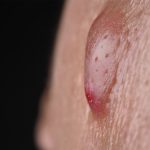
The lump most people call a sebaceous cyst on the shoulder is usually an epidermoid cyst, also known as an epidermal inclusion cyst. Skin cells that should have shed from the surface become sealed inside a pocket in the dermis. That pocket is lined with the same type of cells as your outer skin, and it carries on producing keratin. With nowhere to go, the keratin collects and the cyst slowly enlarges.
Two things follow from that structure. The cyst cannot resolve by itself, because the lining is alive and still producing. And if the contents are drained or squeezed out but the lining is left behind, the pocket refills.
“Removing the entire cystic lining is important in decreasing recurrence.”
Zito PM, Scharf R. Epidermoid Cyst. StatPearls, published by the National Library of Medicine, NIH
The contents are compacted keratin rather than oil or pus, which is why a cyst that bursts produces a thick, pale, strong smelling material. On the shoulder, cysts are often larger by the time they are seen than cysts on the face, simply because they sit under clothing and are easy to live with until a strap starts rubbing.
The six lumps people call a shoulder cyst
The shoulder sits where the skin of the upper back, the upper arm and the base of the neck meet, so it collects the lumps of all three areas. It also has a joint just beneath the surface. Getting the label right decides the treatment.
Smooth, firm, round and moving with the skin, often with a tiny central punctum. Painless unless inflamed. This is the classic shoulder cyst and the one a skin clinic removes.
Soft, doughy and rubbery, sitting deeper than a cyst with the skin gliding freely over it and no punctum. The shoulders and upper back are among its most typical sites. Benign, and removed for comfort or appearance.
Hot, red, tender and swelling quickly, sometimes with a yellow head. Either a cyst that has ruptured under the skin or an infected hair follicle. Needs settling before any planned removal.
A firm, raised, often itchy overgrowth of scar tissue at the site of old acne, a vaccination, a piercing or previous surgery. It is scar rather than a sac, and cutting it out on its own is not adequate treatment.
A soft, fluid filled swelling directly on top of the shoulder joint, usually in an older adult with longstanding shoulder pain or weakness. It comes from the joint, not the skin, and is assessed by an orthopaedic surgeon.
A firm lump fixed in the muscle rather than the skin, or one that keeps growing. Most are benign, but a growing deep lump needs an ultrasound scan before anything else is done.
Why cysts form on the shoulder
The skin over the shoulders and upper back is thick and well supplied with sebaceous glands, which is also why these areas are so prone to acne. Inflamed follicles can damage the follicle opening and leave surface skin cells sealed below it, and that is the usual starting point for an epidermoid cyst. If you have had acne on your shoulders, a cyst in the same area is not a coincidence. Our guide to shoulder acne covers that side of the problem.
Friction adds to it. Bra straps, rucksack straps, handbags and seat belts all press on the same strip of skin day after day, and minor repeated injury can push skin cells into the deeper layer. Friction does not usually cause a cyst on its own, but it is the reason a small, unnoticed cyst becomes sore, inflamed and impossible to ignore.
Epidermoid cysts are most common in adults in their thirties and forties and are more frequent in men than in women. They are not caused by poor hygiene and they are not contagious.
Does a shoulder cyst need removing?
Not necessarily. A small, painless cyst with a confirmed diagnosis can be left alone. Most people who ask about removal on the shoulder have one of three reasons.
- Friction and discomfort. A cyst under a bra strap or rucksack strap is pressed and rubbed all day, which makes it sore and more likely to become inflamed.
- Repeated inflammation. Each flare up scars the tissue around the cyst. A cyst removed between flare ups comes out more cleanly and leaves a better scar than one removed after several episodes of infection.
- Size. Cysts on the shoulder keep growing slowly. A larger cyst means a longer incision on skin that already tends to stretch its scars, so earlier removal usually means a smaller mark.
Whatever the reason, the lump should be examined before it is treated, so that a lipoma, a joint cyst or a deep lump is not mistaken for a simple skin cyst.
Shoulder cyst removal options compared
There are three tiers of treatment, and on the shoulder the third tier, scar control, matters almost as much as the removal itself.
Watch and manage
- ObservationReasonable for a small, stable, painless cyst with a confirmed diagnosis.
- Warm compressEases discomfort in an inflamed cyst. Does not remove it.
- Reduce pressureMoving a strap or switching shoulders for a bag often settles a sore lump.
- Photograph monthlyThe simplest way to notice a change in size or colour.
Definitive removal
- Complete surgical excisionSac removed intact. Recurrence 3.3% at 12 months.
- Minimal or punch excisionSmaller incision. Recurrence 8.3% at 12 months.
- Incision and drainageFor acute infection only. The lining stays, so it refills.
- HistologyTissue sent to pathology to confirm the diagnosis.
Scar control
- Layered closureDeep sutures take the tension so the skin edges are not pulled apart as the arm moves.
- Silicone gel or sheetingApplied once the wound has fully closed.
- Intralesional steroidUsed where the skin has a history of thickened or keloid scarring.
- Sun protectionA new scar on the shoulder darkens easily in summer clothing.
The choice between complete excision and a smaller minimally invasive approach has been tested directly. A study of 120 patients randomised epidermal cysts to conventional complete surgical excision or minimally invasive removal through a small opening made with a CO2 laser, then followed them for 12 months:
| Measure | Complete surgical excision | Minimally invasive laser excision |
|---|---|---|
| Patients | 60 | 60 |
| Recurrence at 12 months | 3.3% | 8.3% |
| Statistical difference | None (P = 0.648) | |
| Mean scar length | 1.23 cm | 0.30 cm |
| Scar difference | Significant (P = 0.001) | |
| Patient satisfaction | Lower | Significantly higher |
Two caveats matter on the shoulder. The study was carried out on facial cysts between 0.5 and 2.2 cm, so it is the closest available comparison rather than a shoulder specific one. And facial skin is thin and under little tension, whereas shoulder skin is thick and stretched with every movement of the arm. A short incision on the shoulder does not automatically give a short final scar, because the scar tends to widen as the skin pulls against it.
The practical reading is that size settles the question. A small, recent cyst can suit a minimal approach. Larger cysts, which most shoulder cysts are by the time they are seen, need a proper excision and a carefully closed wound.
Incision and drainage sits outside that comparison. It relieves an acutely infected, painful cyst, but the lining stays behind, so a planned excision is still needed once the inflammation has settled, usually after four to six weeks.
What happens on the day
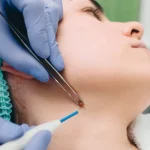
Shoulder cyst removal is a same day procedure carried out under local anaesthetic. The NHS describes the approach for skin cysts: “Local anaesthetic is used to numb the area around the cyst before it’s cut out. You’ll have a small scar after the wound has healed.” Expect to be in clinic for around an hour, sitting or lying on your side for the procedure itself.
Assessment
The procedure
Immediate care
Recovery, scarring and why the shoulder is different
The shoulder heals reliably, but it heals into a scar that is constantly moving. Every time you lift your arm, reach across your body or carry a bag, the skin over the shoulder is stretched. A wound that would settle into a fine line on the face can widen into a broader mark here. That is normal healing rather than a complication, and it is why closure technique and aftercare matter more on the shoulder than on most other sites.
The shoulder is also one of the areas most prone to keloid scars:
“The most commonly affected locations include the deltoid, the pre-sternal chest, the upper back, and the ear.”
McGinty S, Siddiqui WJ. Keloid. StatPearls, published by the National Library of Medicine, NIH
If you have ever formed a raised, itchy scar from acne, a vaccination, a piercing or previous surgery, mention it before the procedure. It changes both how the wound is closed and what is done in the weeks that follow.
Do
- Keep the dressing clean and dry for the first 48 hours
- Move a bra strap or bag strap away from the wound while it heals
- Take paracetamol if the area feels sore
- Return for suture removal at 10 to 14 days
- Start silicone gel once the wound has fully closed and use it for at least three months
- Tell us early if the scar starts to thicken, itch or spread
Avoid
- Overhead lifting, shoulder presses and heavy upper body exercise for four weeks
- Rucksacks and shoulder bags on the operated side
- Swimming, saunas and hot tubs for two weeks
- Sleeping on the wound in the first week
- Picking at the crust or sutures
- Sun on the new scar for at least three months
The four week break from upper body training is the instruction people most often ignore and most often regret. Pressing and lifting movements stretch the skin over the shoulder directly, and a wound that is pulled repeatedly in the first month is the one most likely to leave a wide scar.
Risks and recurrence
Shoulder cyst removal is a minor procedure with a low complication rate, but it is still surgery. The main risks are infection, bleeding or bruising, a scar that stretches or thickens, and recurrence.
Recurrence depends mainly on whether the whole lining was removed. In the study above, 3.3% of cysts came back within 12 months after complete excision and 8.3% after the minimal laser technique. A cyst that is drained rather than removed should be expected to refill. A cyst that has been inflamed several times before surgery is more likely to recur, because the lining is harder to separate cleanly from the scarred tissue around it.
Sending the tissue for histology is standard. It confirms the diagnosis and rules out anything that needs further treatment.
The lump on top of the shoulder joint is a different problem
A soft swelling that sits exactly over the bony point at the top of the shoulder, where the collarbone meets the shoulder blade, is not always a skin cyst. In older adults, particularly those with a long history of shoulder pain or weakness, it can be an acromioclavicular joint cyst. Joint fluid escapes through a tear in the rotator cuff and a worn joint, and collects under the skin as a lump. On a scan the fluid can be seen rising through the joint, which is why it is known as the geyser sign.
“Aspiration of these cysts should not be attempted, due to the high recurrence rate and potential for a draining sinus.”
Cooper HJ, Milillo R, Klein DA, DiFelice GS. The MRI geyser sign: acromioclavicular joint cysts in the setting of a chronic rotator cuff tear. American Journal of Orthopedics, 2011
Because the cause is inside the joint, cutting out the lump alone does not solve it. These cysts are investigated with imaging and treated by an orthopaedic shoulder surgeon, and they are not removed in a skin clinic.
Red flags: when a shoulder lump needs more than removal
Most shoulder lumps are harmless, but a small number need investigation before anything is removed. NICE guidance advises an urgent ultrasound scan, within two weeks, for adults with an unexplained lump that is increasing in size, to rule out a soft tissue sarcoma.
Ask for an assessment before any removal if a lump on your shoulder:
- is getting steadily bigger
- is larger than about 5 cm, roughly the size of a golf ball
- feels hard, fixed or deep in the muscle rather than in the skin
- is painful without being red or inflamed
- has come back after being removed before
- sits on top of the shoulder joint and comes with shoulder pain or weakness
Seek prompt medical advice if a shoulder lump becomes rapidly red, hot and swollen with spreading redness or a fever. These suggest a spreading infection that needs treatment rather than a planned procedure. Related lesions are covered on our skin cysts and keloid scarring pages, cysts on the rest of the back are covered in our guide to back cyst removal, and you can read more about the procedure on our cyst removal treatment page.
FAQs
Will a cyst on my shoulder go away on its own?
No. An epidermoid cyst is lined with living skin cells that keep producing keratin, so it has no way of resolving. It may stay the same size for years, and an inflamed cyst may settle down, but the cyst itself will not disappear. Only removal of the lining clears it permanently.
Can I squeeze a cyst on my shoulder?
No. The NHS advises against squeezing any skin cyst, because it can rupture the sac, spread the contents and cause infection. On the shoulder it also inflames and scars the tissue, which makes later removal harder on skin that is already prone to thickened scarring.
Is the lump on my shoulder a cyst or a lipoma?
A cyst sits in the skin and moves with it, feels firm and often has a small central pore. A lipoma sits deeper, feels soft and rubbery, and the skin slides freely over it. Both are usually harmless, but they are removed differently, so the lump should be examined first.
Does shoulder cyst removal hurt?
The local anaesthetic injection stings for a few seconds. After that the area is numb and the procedure is felt as pressure and movement only. Most people need nothing stronger than paracetamol afterwards, though the shoulder may feel bruised for a few days.
How long does shoulder cyst removal take and what is the recovery?
A straightforward cyst usually takes 20 to 30 minutes, with around an hour in clinic. Most people return to desk work the same or next day. Sutures on the shoulder are usually removed after 10 to 14 days, and heavy upper body exercise should be avoided for about four weeks.
Will shoulder cyst removal leave a scar?
Yes, any removal leaves a scar. On the shoulder it can widen because the skin is stretched with every arm movement, and the area is prone to keloid scars. Careful closure, avoiding heavy lifting in the first month, silicone gel and sun protection all help the scar settle.
Will a shoulder cyst come back after removal?
Recurrence was 3.3% at 12 months after complete surgical excision and 8.3% after minimally invasive laser removal. If the cyst is only drained and the lining is left behind, it should be expected to refill.
What is a lump on top of the shoulder joint?
A soft swelling exactly over the top of the shoulder joint in an older adult with shoulder pain can be an acromioclavicular joint cyst, caused by joint fluid escaping through a rotator cuff tear. It is not a skin cyst, should not be drained, and is assessed by an orthopaedic surgeon.
Sources
- Zito PM, Scharf R. Epidermoid Cyst. StatPearls Publishing. National Library of Medicine, National Institutes of Health.
- NHS. Skin cyst. National Health Service, United Kingdom.
- McGinty S, Siddiqui WJ. Keloid. StatPearls Publishing. National Library of Medicine, National Institutes of Health.
- Kim KT, Sun H, Chung EH. Comparison of complete surgical excision and minimally invasive excision using CO2 laser for removal of epidermal cysts on the face. Archives of Craniofacial Surgery, 2019;20(2), pages 84 to 88.
- Cooper HJ, Milillo R, Klein DA, DiFelice GS. The MRI geyser sign: acromioclavicular joint cysts in the setting of a chronic rotator cuff tear. American Journal of Orthopedics, 2011;40(6), pages E118 to E121.
- National Institute for Health and Care Excellence. Suspected cancer: recognition and referral (NG12).
This article is for information only and does not replace an assessment in person. If you have a lump on your shoulder that is growing, painful or that you cannot account for, please see a clinician.