
Moles are an incredibly common form of skin growth. It’s likely that there are at least one or more moles you are aware of on your body and face. The majority of people tend to have anything from 10 to 40 moles on their skin somewhere. But can you get moles removed?
It’s a question on most people’s minds.
As most moles are usually harmless, they are not really something you need to worry about and only need to be removed if they bother you.
Since you’re reading this, we assume you fall into the camp where your moles affect your quality of life.
If you want moles removed because they catch on your clothes or affect your appearance, yes, you can get moles removed.
There are some important considerations to make, as well as various options that we’ll take you through in this post:
Can moles be removed permanently?
Depending on the method used for mole removal treatment, moles can generally be removed permanently if a qualified and experienced dermatologist or surgeon is performing an excision removal.
After surgical excision, tissues will usually be checked in a lab to make sure that, not only has the whole mole has been removed, but also to double-check that it is not cancerous (though this is normally done before)
However, if only a partial excision of the mole is achieved, then the mole can potentially grow back. This can happen with the shave excision method, though the chances are small.

Though the flip side is that shave excision has less risk of scarring and still a good chance that the mole is permanently removed. For cosmetic purposes, this is a good option.
If the mole is cancerous, surgical excision will be the method used to remove all cells of the mole.
Home remedies have varying degrees of success and generally aren’t recommended, not just for potential lack of permanence but because you can’t tell for sure if a mole is cancerous and could make the situation worse.
Always consult a professional.
But if you’re concerned about a mole, here’s how you can do a mole check at home to determine whether you should get it checked out by a professional – if in any doubt, do so!
Want a Personal Consultation to Find Out if Mole Removal is the Right Treatment For You?
Book today with One of Our Experienced Dermatologists
Can I get a mole removed on the NHS?
The truth is, that it really depends. If the mole is considered cancerous or life-threatening, you will be able to have it removed through the NHS.
If your mole is considered a “cosmetic” issue and procedure, then you will not be eligible to have it removed on the NHS
To establish whether there is a need to remove it or not, for anything other than cosmetic reasons, you need to book an appointment to see your GP who will diagnose it and then refer it to a dermatologist who will inspect and assess it further.
If it is discovered to be cancerous, your GP will refer you for treatment through the NHS.
However, if it is a benign mole, you will only be able to have it removed by a private practice or clinic.
Can I remove a Mole myself?
The question you should really be asking is “should I remove a mole myself”. It’s true that it is possible (with varying degrees of success).
There has been a growing trend in recent years of people using DIY mole removal methods.
Whether it’s through apparently specially-formulated creams and lotions or using completely DIY methods involving things you may have around your home, it may be possible to remove moles.
However, most, if not all of these mole removal techniques are either, untested, unproven and ineffective or dangerous.
Why Mole Removal At Home Is a Bad Idea
If you’ve read any website or blog post on DIY mole removal methods you may think they sound very convenient and easy.
However, as we noted above, as well as being untested, unproven, and ineffective, many DIY mole removal methods are simply dangerous and not worth the risk. Why?
There are three main risks that can come from using DIY mole removal methods:
Using lotions or creams
Creams that have been specially formulated to remove mole may sound perfectly fine, but a lot of research has been conducted that shows these kinds of products may cause an increase in the risk of developing keloids.
Keloids are big and raised scars.
They are not only irritating and uncomfortable but are actually bigger and less inconspicuous than the actual mole you were trying to remove.
Any DIY mole removal method that involves cutting it off
Or any other form of self surgery, poses a number of risks.
For one thing, there is a huge risk of infection.
When surgery is performed on any part of the body it is vital that the location and environment where the surgery is being performed along with the tools that are going to be used are sterile.
Not knowing exactly what you are removing
The biggest risk to removing moles at home by yourself is not knowing exactly what you are removing.
Aside from the fact that you could bleed out and not be able to stop it if you make too big an incision, without a professional medical diagnosis, there is no way of knowing whether a mole is cancerous or not.
If it is cancerous and you try to remove it yourself, you could cause the infected cells to spread, which could increase the chance of you developing other types of cancer.
How much is it to get a mole removed in the UK?
When it comes to having a mole removal procedure at a clinic like Lina Skin Clinic in London, the price is determined, firstly by the type of mole removal you want, and secondly by how many moles you want to have removed.
For a mole shave, it will cost £250 for a single mole, £400 for two and another £100 for any extra.
For a mole curettage, it will cost £180 for a single mole, £300 for two and another £100 for any extra.
For a mole excision, it will cost £350 for a single mole, £800 for two and another £250 for any extra.
For mole laser removal, it will cost £300 for a single mole, £500 for two and another £200 for any extra.
What’s the Best Way to Remove a Non-Cancerous Mole?
As there are a number of different techniques and methods used to remove non-cancerous moles, you may wonder which is the best. The truth is it depends really on the location, size, and type of mole.
At Linia Skin Clinic, the options available are:
- Surgical shaving
- Curettage
- Surgical excision
- Laser removal
The specialist you meet with for your consultation appointment will offer suggestions and recommendations about the best options based on the above factors.
What Happens When You Get a Mole or Skin Tag Removed?

Mole removal and skin tag removal are two procedures that are fairly simple when performed by qualified, experienced, and skilled professionals.
They can be performed as an outpatient form of surgery and may take place in a clinic or office.
Although the results are ultimately the same, there are obviously differences in what to expect from each type of mole removal treatment.
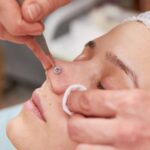
With surgical excision, the doctor numbs the mole and the surrounding area and uses a sharp circular-shaped blade or a scalpel to cut the mole out from your skin, taking some of the healthy skin with it.
Once removed, they will stitch your skin back up, closing the wound.
With a surgical shave, after numbing the mole and the surrounding area, the doctor or dermatologist will shave the mole off and some of the tissue underneath it, slowly and carefully.
Generally speaking, stitches are not necessary following this procedure.
With laser removal powerful light energy is used to break down the mole’s pigments. This is often a good option for mole removal from your face as there is less chance of any scarring.
Although the methods are similar to mole removal, if you have a skin tag removed it may involve:
Snipping – this is fairly self-explanatory and simply involves the doctor numbing the area and then using special scissors to cut or snip the skin tag off.
Freezing – again, very self-explanatory and involves the doctor using extremely cold liquid nitrogen to remove your skin tag. This is less immediate as it will take between 10 and 14 days for the skin tag to drop off following treatment. It can also cause irritation on the skin around your skin tag.
Burning – involves using an electrode to pass an electrical current into the skin tag, drying out its tissue and causing it to fall off.
Book today For Your Personalised Mole Removal Consultation with One of Our Experienced Dermatologists to See How we Can Help