The skin, our largest organ, is decorated with a range of various patterns and textures which make each of us an individual. Two common types of skin markings that we often encounter are birthmarks and moles. While both natural, generally harmless, and with some overlapping properties, birthmarks and moles aren’t entirely the same thing.

What are moles?
Moles are spots on the skin made from groupings of cells called melanocytes. These cells are responsible for producing pigment in the skin, so when they cluster together, small, dark, highly pigmented patches form. This is a mole.
Most people have at least a few moles, with the average person likely to have between 10 and 40 moles. Moles can occur throughout the body.
What are birthmarks?
As the name suggests, a birthmark is a skin marking that is present at birth or appears shortly after, typically within the first month. They can vary greatly in shape, size and colour, appearing anywhere on the skin’s surface.
There are two types of birthmarks – vascular and pigmented. Vascular birthmarks, such as port-wine stains and strawberry hemangiomas, are caused by abnormal blood vessels in the skin. Pigmented birthmarks are caused by excess growth of pigmented cells in a certain area. The three types of pigmented birthmarks include café-au-lait spots, Mongolian spots, and moles which have been present since birth.
So what’s the difference between moles and birthmarks?
Whilst moles can technically be birthmarks, not every mole is a birthmark. Some of the key differences between the conditions include:
Time of development
Birthmarks are present at birth, whereas moles generally develop throughout childhood and adolescence. Moles not present at birth are therefore not considered birthmarks. Whilst moles are generally caused by genetic factors, they can arise due to environmental factors such as sunlight exposure. This means that unlike birthmarks, moles can appear later in life and with age – although birthmarks can change in appearance over time.
Appearance
You might be wondering whether markings on your skin are a birthmark or a mole. Sometimes there can be distinct visual differences between the two.
Vascular birthmarks tend to be larger than moles and made up of colours like pink, red, and purple. Pigmented birthmarks look much more similar to moles, but there are some subtle differences. Mongolian spots are flat, grey-bluish patches, usually quite large and originating around the lower back. Café-au-lait spots are flat, light brown marks which can be any shape.
Alternatively, moles are usually small, round or oval shaped spots which are usually dark brown, black, or tan in colour. They may even be pink. Moles can be smooth or have hairs growing out of them, and they can be flat or raised.
Health implications
Generally, both birthmarks and moles carry little health risks. On rare occasions, birthmarks can indicate the presence of underlying conditions or may need to be treated.
Moles, whether a birthmark or not, have the potential to turn into the skin cancer known as melanoma. This is not common, but as an early preventative measure, it’s important to monitor all moles for changes in size, shape and colour, or any other symptoms like itching or bleeding.
Is it a birthmark or a mole?
Differentiating between a birthmark and mole can be challenging, but learning more about your unique skin complexion can help you to monitor your skin safety and detect any changes. Regardless of whether it is a birthmark or mole, if you notice something different or unusual about a skin marking, it’s important to consult a dermatologist to get checked.
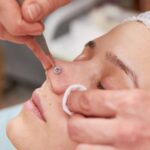
At LINIA Skin Clinic, we can put your mind at ease with our mole check service. It’s always better to be safe than sorry, and at our expert clinic, our highly skilled professionals can answer any concerns and talk through your options. To learn more about mole checks, get in touch with our professionals to arrange your consultation.