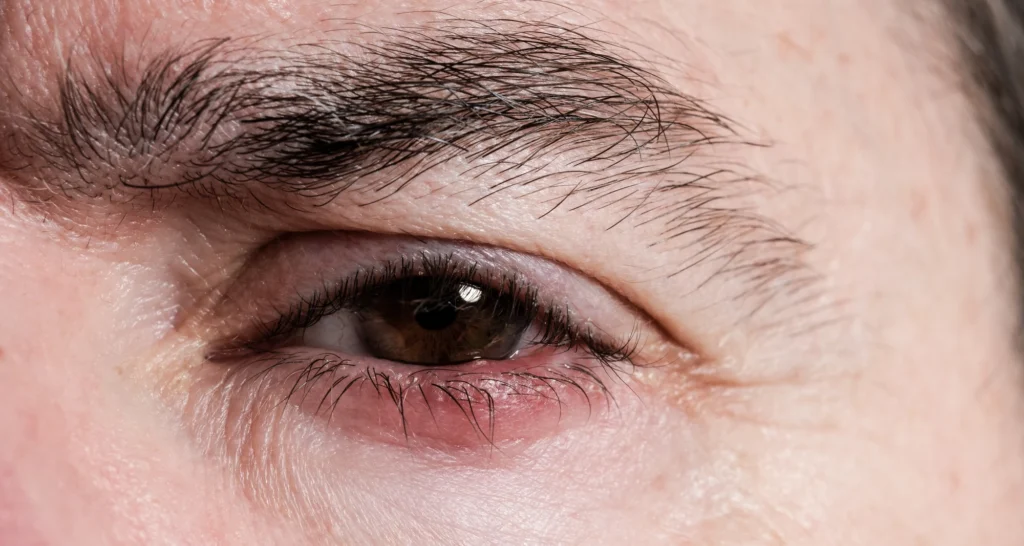
An eyelid cyst is a blocked oil gland rather than a growth, and most settle without surgery. This guide explains which lumps need removing, what each removal method involves, the published success and recurrence rates, and the warning signs that mean a lump should be biopsied rather than simply drained.
What an eyelid cyst actually is
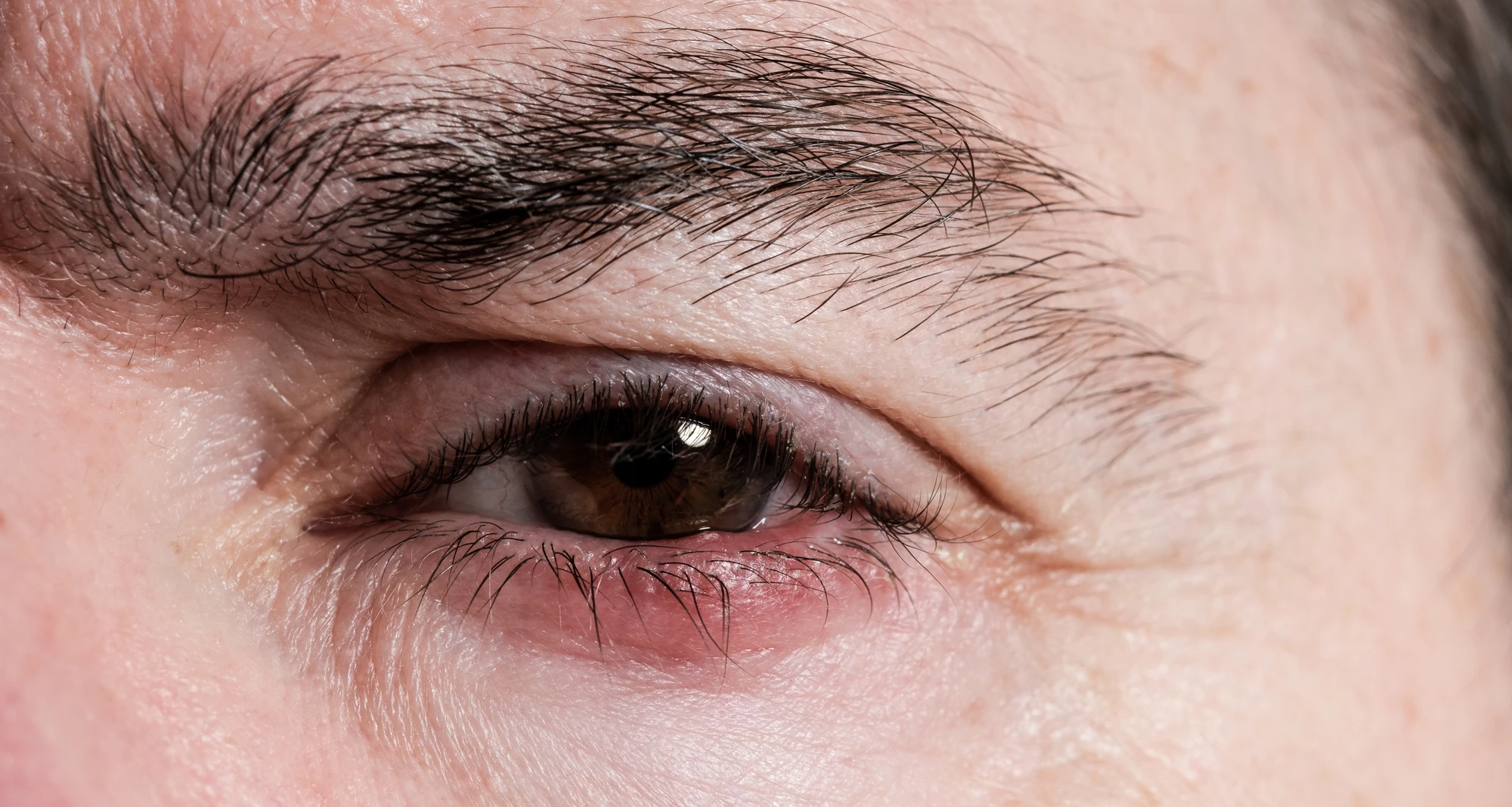
Each eyelid holds roughly 25 to 40 meibomian glands in the upper lid and 20 to 30 in the lower lid. These glands secrete the oily layer that stops your tear film evaporating. When one blocks, the trapped oil leaks into the surrounding tissue and the body walls it off with an inflammatory reaction, producing the firm lump commonly called an eyelid cyst.
“A chalazion is a localized, lipogranulomatous lesion of the eyelid… 13.4% of all benign lid lesions are chalazia.”
University of Iowa, Department of Ophthalmology and Visual Sciences. EyeRounds clinical case archive
The word cyst is slightly misleading. A true chalazion contains no fluid and no infection. It is granulomatous tissue. That distinction matters, because it explains why antibiotics rarely help and why squeezing achieves nothing except bruising.
The four types you might have
Treatment differs by type, and the two most common are routinely confused with each other.
Firm, rubbery, usually painless, sitting within the lid away from the lash line. Chronic and not infectious. This is the lump most people mean by “eyelid cyst”.
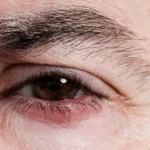
Red, tender and filled with pus, sitting on the lid margin at the base of a lash. Acute and bacterial, typically Staphylococcus aureus. Often resolves within a week.
A smooth dome the colour of skin, filled with keratin, sitting in the eyelid skin itself. It will not shrink with compresses and needs excision of the whole sac.
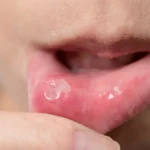
Small translucent (Moll, sweat gland) or opaque yellow white (Zeis, sebaceous) blisters on the lash line. Harmless, removed for cosmetic reasons or if they catch.
Does it need removing?
Often, no. Conservative treatment is the correct first step for both chalazia and styes, and the published figures are encouraging.
“Most chalazia resolve within one month with these conservative measures.”
Jordan GA, Beier K. Chalazion. StatPearls, published by the National Library of Medicine, NIH
The NHS recommends the same approach for styes, with a specific protocol worth following precisely rather than approximately:
“Soak a clean flannel in warm water. Hold it against your eye for 5 to 10 minutes. Repeat this 2 to 4 times a day.”
NHS, Stye. The same guidance notes that styes “should go away within a week”.
Heat works because meibomian oil melts at around 32 to 40°C. A compress held for 30 seconds does nothing. One held for a full 5 to 10 minutes, repeated several times daily for two weeks, is what produces the 40 to 80% clearance rate. Follow it with a gentle downward massage of the upper lid to express the softened oil.
Consider removal when: the lump persists beyond four to six weeks of correct conservative care; it is large enough to press on the cornea and blur vision (a chalazion can induce astigmatism); it recurs repeatedly at the same site; it is cosmetically distressing; or the diagnosis itself is uncertain.
Eyelid cyst removal options compared
Three tiers, from home care to definitive surgery.
Conservative care
- Warm compresses5 to 10 minutes, 2 to 4 times daily, for two weeks.
- Lid massageGentle pressure towards the lash line after heat.
- Lid hygieneDilute cleanser or lid wipes to clear crusting.
- Treat the causeBlepharitis and rosacea drive recurrence.
Procedural
- Intralesional triamcinolone4 mg injection. 81% resolution, mean 5 days.
- Incision and curettage79 to 90% resolution. Allows histology.
- Surgical excisionFor epidermoid cysts. The sac is removed whole.
- Radiofrequency or cauteryFor small superficial Moll and Zeis cysts.
Recurrence control
- Omega 3 supplementationMay improve meibomian secretion quality.
- Oral doxycyclineLow dose where rosacea drives the blepharitis.
- Intense pulsed lightEmerging option for meibomian dysfunction.
- Makeup disciplineRemove eyeliner nightly. Replace mascara every three months.
The choice between injection and surgery is not obvious, and it has been tested directly. A prospective randomised trial of 94 patients with primary chalazia that had failed conservative treatment compared intralesional triamcinolone acetonide against incision and curettage:
| Measure | Steroid injection | Incision and curettage |
|---|---|---|
| Resolution rate | 81% (42 of 52) | 79% (33 of 42) |
| Statistical difference | None (P = 0.8) | |
| Treatments needed | 92% needed one injection only | Single procedure |
| Time to resolution | Mean 5 days | Immediate debulking |
| Anaesthetic | Topical or minimal | Local injection |
| Tissue for histology | No | Yes |
The trial authors concluded that injection “is as effective as I&C in primary chalazia” and “may be considered as an alternative first-line treatment in cases where diagnosis is straightforward and no biopsy is required.” That final clause is the deciding factor. If there is any doubt about what the lump is, incision and curettage wins because it yields tissue.
For an assessment of which route suits your lump, see our cyst removal treatment page.
What happens on the day
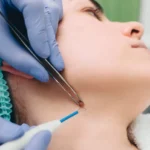
Eyelid cyst removal is a same day procedure. Total clinic time is usually under an hour, with the procedure itself taking 15 to 20 minutes.
Assessment
The procedure
Immediate care
Recovery and aftercare
Bruising and swelling peak at 24 to 48 hours and settle over roughly a week. Vision is not affected by the procedure itself, though ointment blurs it temporarily.
Do
- Apply the prescribed ointment for the full course
- Use a cool compress for the first 24 hours to limit swelling
- Sleep with your head slightly elevated for two nights
- Take paracetamol if the lid feels tender
- Resume warm compresses after 48 hours to keep the glands clear
- Attend the review, especially if tissue was sent to pathology
Avoid
- Eye makeup for 7 days
- Contact lenses until the lid is comfortable, usually 3 to 5 days
- Swimming pools and saunas for 2 weeks
- Rubbing or pressing the treated lid
- Strenuous exercise for 48 hours
- Squeezing any residual firmness, which resolves on its own
A small firm nodule often remains for four to six weeks after curettage. This is scar tissue remodelling rather than a failed procedure, and it usually flattens without further intervention.
Risks, scarring and recurrence
Complications are uncommon, but recurrence is the figure patients most often want and least often get told.
- Recurrence
- Between 22% and 26% of patients treated with incision and drainage develop a recurrence within two years of follow up. Recurrence is far more likely where underlying blepharitis or rosacea is left untreated, which is why lid hygiene continues after the lump has gone.
- Scarring
- Negligible with the internal approach, since the incision is hidden on the conjunctival surface. External incisions leave a fine line that fades over three to six months.
- Steroid risks
- Intralesional triamcinolone can cause localised skin depigmentation and fat atrophy, more visible in deeper skin tones. Raised intraocular pressure is rare but documented.
- Bleeding and infection
- Minor oozing for a few hours is expected. Genuine infection after the procedure is rare, and the ointment course is precautionary.
- Lid notching
- A very rare cosmetic irregularity of the lid margin, avoided by keeping the incision perpendicular to and away from the margin.
Red flags: when a cyst is not a cyst
This is the single most important section on the page. A small number of eyelid malignancies, sebaceous carcinoma in particular, present as what looks exactly like an ordinary chalazion, and can be drained repeatedly before anyone questions the diagnosis.
“An additional benefit of I&D is that tissue may be sent to pathology to confirm the diagnosis, which is particularly useful in situations where the lesions are recurrent or clinically do not appear clearly to be a chalazion.”
University of Iowa, Department of Ophthalmology and Visual Sciences. EyeRounds clinical case archive
The NHS is equally direct about what not to do to an inflamed lid in the meantime:
“Do not try to burst a stye or remove an eyelash yourself. This can spread the infection.”
Seek same day medical attention if a lid lump comes with fever, vision loss, double vision, or spreading redness across the cheek or forehead. These can indicate orbital cellulitis, which requires intravenous antibiotics rather than a cosmetic procedure. Related lesions are covered on our skin cysts page.
FAQs
Is eyelid cyst removal painful?
No. Local anaesthetic is injected into the lid after numbing drops, so the procedure itself is felt as pressure rather than pain. The anaesthetic injection stings for a few seconds. Most patients need nothing stronger than paracetamol afterwards.
How long does the procedure take?
Incision and curettage takes 15 to 20 minutes. A steroid injection takes under 5 minutes. Including consultation and consent, expect to be in clinic for around an hour.
Will it come back?
Between 22% and 26% of chalazia recur within two years of incision and drainage. The risk drops substantially when underlying blepharitis or rosacea is treated at the same time and lid hygiene is maintained over the long term.
Can I just leave it alone?
Frequently, yes. Around 25 to 50% resolve spontaneously and most of the rest respond to warm compresses within a month. Removal is indicated if it persists beyond four to six weeks, blurs vision, keeps recurring, or the diagnosis is uncertain.
Will there be a visible scar?
Usually none. Most eyelid cysts are approached from the inner surface of the lid, leaving no external mark. Where an external incision is necessary, it is placed in a natural crease and typically fades within three to six months.
When can I wear makeup and contact lenses again?
Eye makeup after 7 days, contact lenses once the lid is comfortable, which is usually 3 to 5 days. Replace any mascara or eyeliner used shortly before the cyst appeared.
Is an eyelid cyst ever a sign of cancer?
Rarely, but it is important. Sebaceous carcinoma can mimic a chalazion closely. A lump that recurs at the same site, causes lash loss, distorts the lid margin, or fails to respond to proper treatment should be biopsied rather than drained again.
Does a steroid injection work as well as surgery?
In a randomised trial of 94 patients, resolution was 81% with intralesional triamcinolone and 79% with incision and curettage, with no statistically significant difference. Injection resolved lesions in a mean of 5 days and 92% of patients needed only one. Surgery remains preferable when tissue is needed for histology.
Sources
- Jordan GA, Beier K. Chalazion. StatPearls Publishing. National Library of Medicine, National Institutes of Health.
- NHS. Stye. nhs.uk/conditions/stye.
- University of Iowa Department of Ophthalmology and Visual Sciences. Chalazion. EyeRounds.
- Ben Simon GJ, et al. Intralesional triamcinolone acetonide injection versus incision and curettage for primary chalazia: a prospective, randomized study. American Journal of Ophthalmology, 2011;151(4), pages 714 to 718.
Medically reviewed by Dr Simon Zokaie, MBChB, MRCP, Medical Director at Linia Skin Clinic. This article is for information only and does not replace an assessment in person. Last reviewed August 2026.